Design consideration for voice-based chatbot on zoo
Contributor : Muchammad Ersan Ramadhan, Dr. Sarah Webber
Period : March 2020 - June 2020 (12 Weeks)
picture by Personal documentation
Overview
Zoos are trialling a range of digital technologies aiming to enhance the visitor experience. Voice-based chatbots are of interest as a tool that offers new ways of interaction for visitors to learn about animals. This project explores the opportunities for voice-based chatbots to be used in zoos and how it might be deployed to enhance the visitor experience. We studied a prototype voice-based chatbot deployed at a zoo and conducted interviews with zoo visitors to investigate their perceptions and expectations of this type of technology.
We developed new insights into how voice-based chatbots might be designed to address visitor preferences and zoos’ educational mission. We presents four considerations for design of the conversational user experience (UX) and the physical interface of a voice-based chatbot for zoos. We expect such design enhancements in both aspects could provide interactive features that might enhance zoo visitor’ experiences.
What I have done
Explored topics about technology on zoos and conversational UX.
Looked the opportunity and gap for this project.
Developed and raised research questions.
Conducted Online Interviews and collected qualitative data.
Did thematic analysis to categorise findings.
Raised 3 themes of key findings.
Proposed design consideration for conversational UX.
Proposed design consideration for physical interface of voice-based chatbot.
Challenge and Research Gaps
Challenge: several technologies (e.g.; screen-based technology) can interfere with the experience of visitors to enjoy the surroundings and interact lively with animal.
Research Gap: literature and research regarding the utilization of voice-based chatbots in the zoo are still limited, hence there are still many opportunities for improvement.
Aims and Opportunity
Aim: Develop a technology that can provide a balance interaction between visitors, animals and technology
Oppotunity: Choosing that kind of tech is really tricky, but technology with voice-based interaction, such as voice-based chatbot might be implemented at the zoo and as an opportunity to be appealing solution for supporting the visitors, especially families with young children, to learn about animal without getting much distraction looking at or interact with the technologies
Research Questions
From the aim mentioned above, I raised three research questions;
RQ1: How visitor experience can be enhanced by providing a voice-based chatbot?
RQ2: What are the conversational UX design considerations of voice-based chatbots in zoos?
RQ3: What are the physical interface design considerations for voice-based chatbots in zoos?
Methods
I used semi-structured interviews techniques to gather the qualitative data. Semi-structured interviews techniques was used to collect as much data and information as possible about the voice-based chatbot utilization from the participants by allowing them to speak as much as they want.
I planned to carry out direct observation and also interviews with voice-based chatbots users in the zoo. However, with the current global pandemic situation that requires us to reduce direct contact between individuals, and closure of the zoo due to restrictions from local authorities, we conducted interviews remotely by using Skype or Zoom.
Limitation: A limitation of the remote interviews was that they did not provide any opportunity for participants to interact with the technology.
Participants
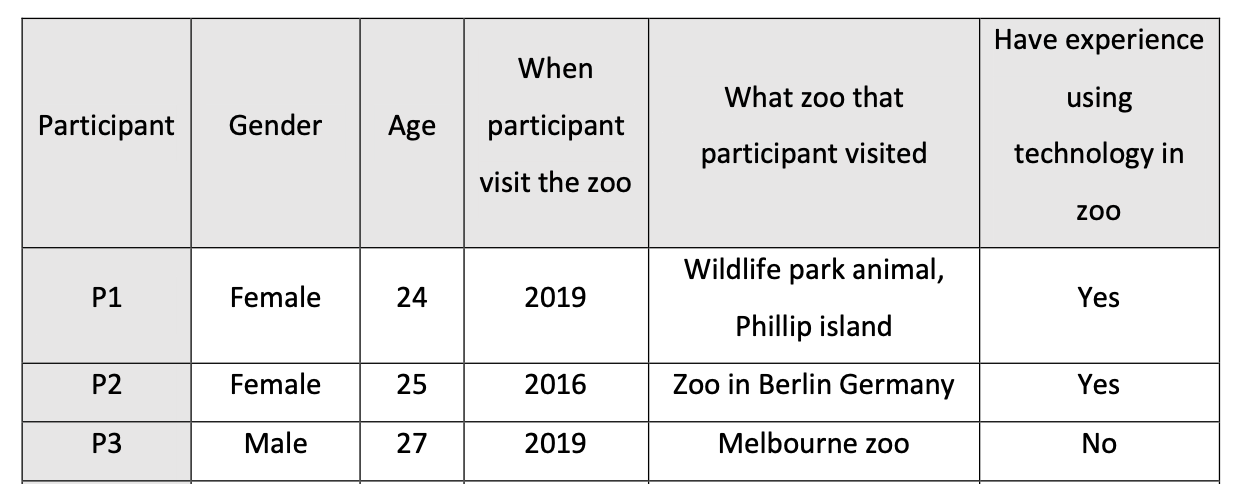
I recruited and interviewed 11 participants with 8 women and 3 men. Participants age ranged from 24 to 44 years old (median = 25 and mean = 28).


Preview of participant data
Video Presentation for Participants
I created a video demonstrating the HelloZoo prototype voice-based chatbot in the zoo. The 2-minute video provides footage of how technology looks like, where it was installed, and examples of a visitor interacting with it. The purpose of the video is to show the interviewees that this technology already exists and is being used in real life.
Procedure of Interview
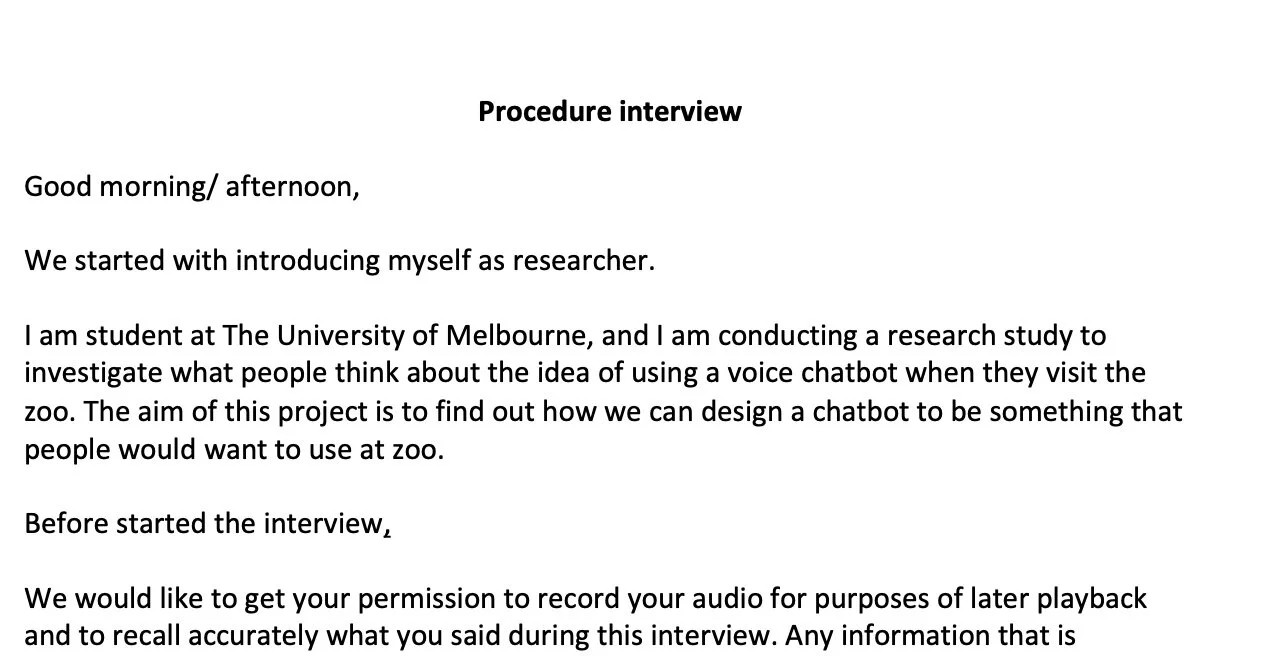
Several interviews were performed in respondent’s native language (Bahasa Indonesia, also native language of the researcher) because it was more convenient for the participant and made it easier to express their thought.

The interview was divided into 2 sections;
Throughout the first section, we discuss in depth about participants’ experience during their zoo visit which includes the situation at the zoo, the purpose of zoo visit, and their use of existing technology in the zoo.
The second section began with a video presentation about the existing Chatbot in Melbourne Zoo. Then, I gathered the reaction and the opinion about technology in the video, potential difficulties and opportunities for improvements by asking them questions.
Preview of Interview Script
Analysis
How I analyse the data?
I transcribed all of the interviews to produce a document of 34 pages.
I followed the thematic analysis stage process raised by Braun & Clarke (2006) and create several themes according to our findings.
Processes of themes selection began with analysing 230 comments that we identified from interviews transcript.
I coded every comment and tried to classify the comments into several themes.
Finally, I construct 3 high-level of themes on findings
High Level of Themes from qualitative data
My findings were categorised into 3 themes;
Visitors’ motivations or intentions will significantly influence their expectations towards the voice-based chatbot
Physical interface of the voice-based chatbot
Interactivity of the voice-based chatbot.
Preview of findings
This is the preview of my findings, and show how I tell a participant’s thought. This finding was grouped on the the first theme.
6 out of 11 participants said that visitors with educational purposes, such as students and family with children, would have positive reactions towards voice-based chatbot at the zoo. As mentioned by participant 1, students on school excursions are more likely to collect information about animals and by using a voice-based chatbot. The chatbot allows them to obtain the required data and information faster.
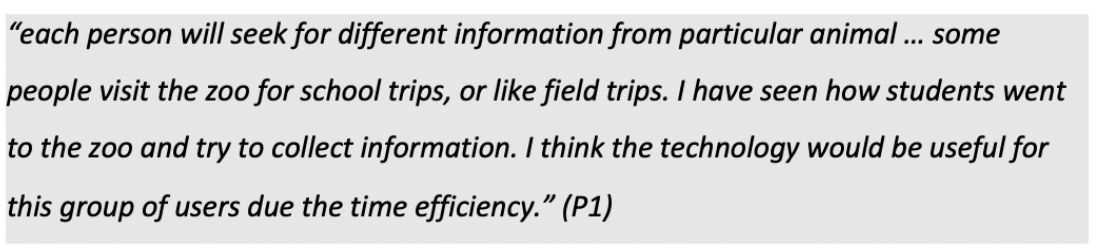
Figure 1 Comment from participant 1
Answering the Research Questions
This project aims to investigate how the zoo visitors’ experience could be enhanced by providing voice-based chatbots. An important consideration is how to design interaction with voice-based chatbots to be part of a pleasant zoo visit experience. We now return to the research questions in order to discuss our contribution towards voice-based chatbot
RQ 1
RQ1: How Voice-based Chabot enhance visitors’ experience?
I can indicate that visitors will have either educational or primarily recreational purpose.
Visitors with educational purposes were more interested in information obtained from voice-based chatbots. They primarily came to the zoo for learning about animals, get animals knowledge, or they want to educate their kids.
Many of them visit the zoo for recreational purposes, such as to relax with family or hang out with friends. They are more interested in how the system behaves and the interactive features this technology has to offer
Insight: Findings indicate that the use of voice-based chatbot could positively contribute to the experience and satisfaction of people who visit with or without educational agenda.
RQ 2
RQ2: What are the design considerations for conversational UX in zoos?
In the zoo, several visitors are usually curious about animals, This tool is expected to be a new useful and intriguing way to get information about animals. It is apparent from the findings that chatbot design should consider visitors’ needs regarding animal information as well as how the information can be conveyed in a way that is accessible and intuitive.
In this study, some of the issues and challenges for interacting with a voice-based chatbot in the zoo relate to conversational UX, the design of voice-based interactions which mimic human conversation.
Accordingly, I propose design considerations for conversational UX in the zoo, based on the insights from our investigation.
Considerations for conversational UX design in zoos
Voice-based chatbot should inform visitor of its capabilities.
Voice-based chatbot should provide broad topic coverage informed by to visitors’ frequently asked questions.
Voice-based chatbot should provide an error-prevention feature.
Voice-based chatbot should display a visual indicator.
Insight: Designing voice-based chatbot on zoo should consider how information can be conveyed as similar as mimic human conversation or called conversational UX.
RQ 3
RQ3; What are the Design consideration for VBC physical interface in zoo?
Our study indicated that participants might have difficulties to notice Melbourne zoo’s HelloZoo prototype because of its unobtrusive appearance. The physical form of the device would have a considerable impact on effectiveness and user perceptions, in this setting. It seems that these issues would affect user’s impression of chatbot. It would be difficult to build the early engagement as visitors would pay little attention to the chatbot
Designing a conversational UX for voice-based chatbots must be supported with a careful design of the physical appearance. As expert said that physical appearance, such as visual elements, may enhance conversational experiences itself.
Therefore, we propose four approaches to enhance physical design of the voice-based chatbot in the zoo based on the insight from our investigation. These four design approaches are represented in a visual design concept, presented below.
Considerations for designing Chatbot physical interfaces in zoos
The Start and stop button features
Well-defined instructions for users
An attractive chatbot installation
The application of multimodal interactions
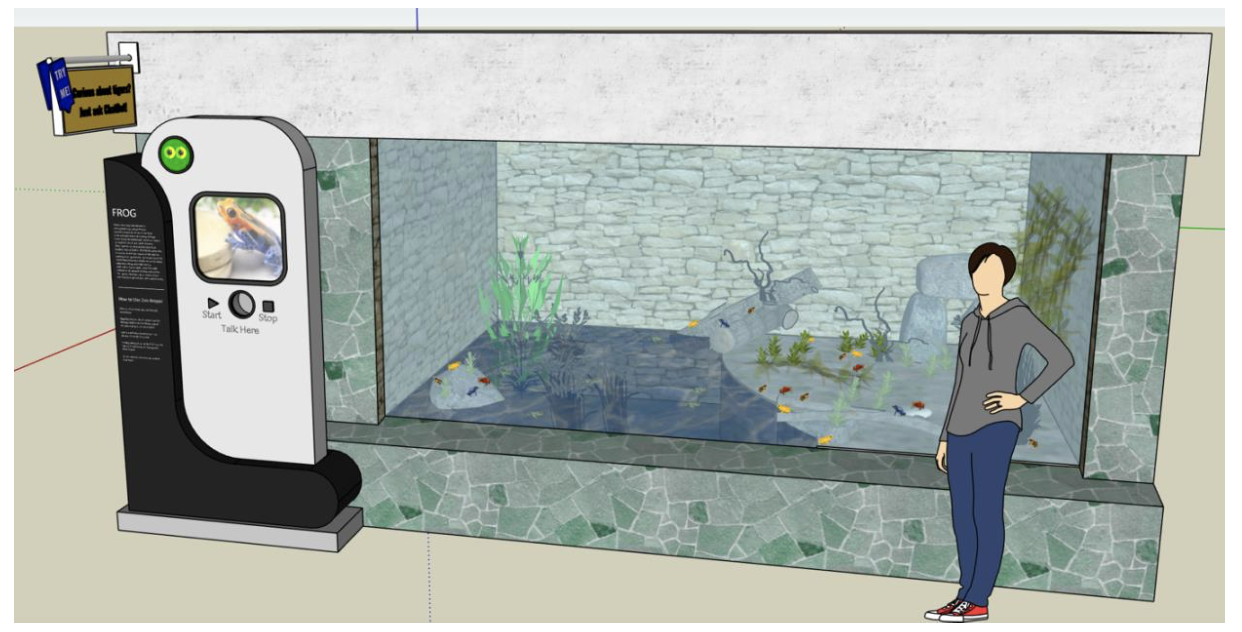
Physical interface design for the voice-based chatbot part 1
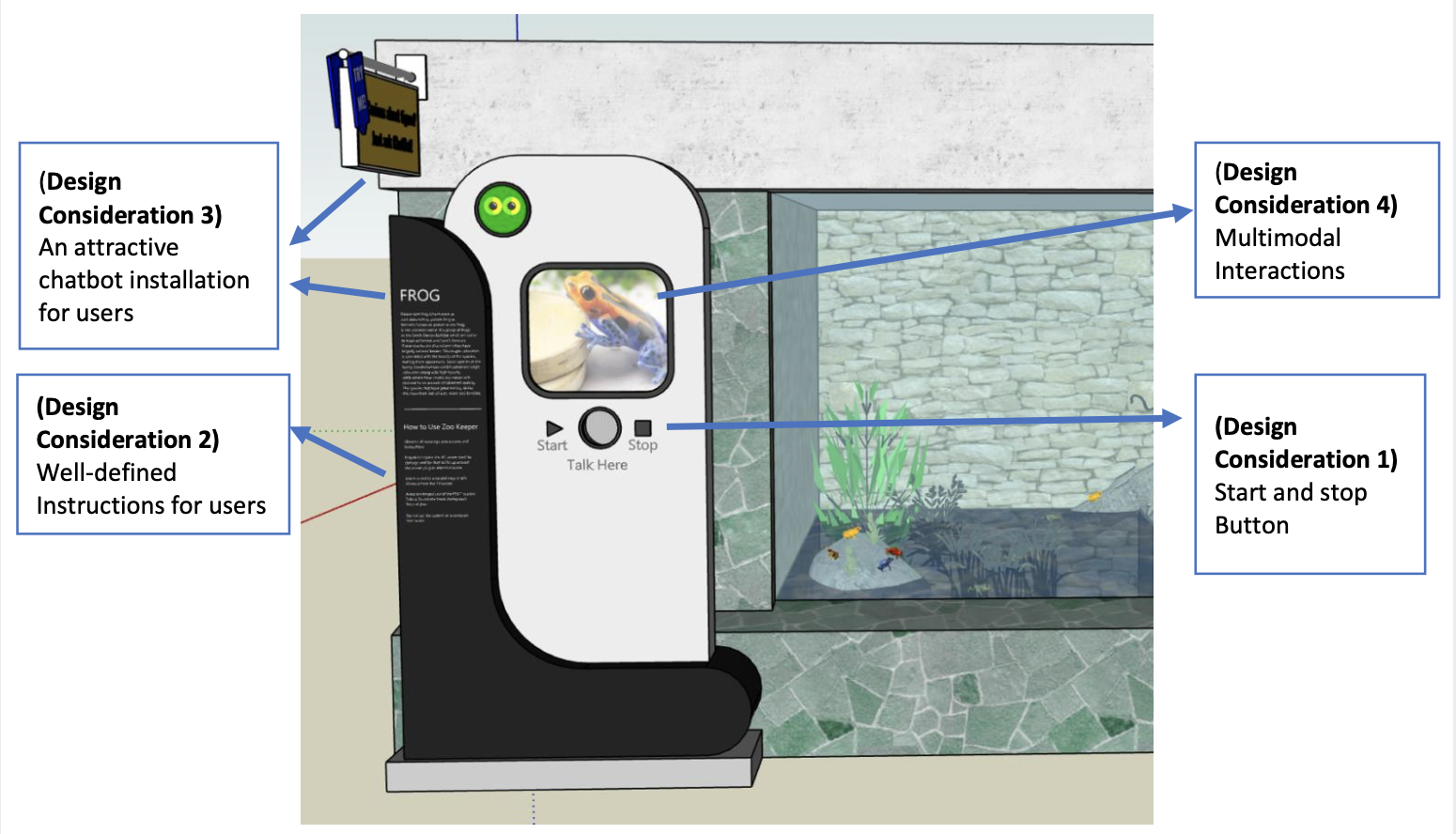
Physical interface design for the voice-based chatbot part 2
Insight: Designing a conversational UX for voice-based chatbots must be supported with a careful design of the physical appearance.
Limitations & Further Research
1.Unable to directly observe the chatbot in use through qualitative fieldwork
The participants were not able to experience a real interaction with the chatbot, and their lack of experience was likely to limit their insight and perceptions of they would use it as part of a zoo visit.
Further research: fieldwork analysis and direct observation should be conducted to gain deeper and more nuanced a reactions and judgement from real users.
2.homogeneity of study participants
Our participants were mostly Indonesian, and they shared a similar culture background. There might be a cultural influence within their thought or opinions which will also impact in how they interact with the system
Further research: using a random method for participants recruitment from the zoo visitor, the interview results are expected to be more variative.
Contribution
This project provides a first examination of the role that voice-based chatbots might play in zoos and offers design strategies for creating and installing these technologies to positively contribute to visitors’ experience and educational objective on zoo
Final Thought
I found indications that voice-based chatbot could support people’s experience at the zoo, whether their visit is motivated by an educational agenda or not.
Voice-based chatbots for the zoo should offer a strong conversational user-experience design, multimodal interaction and content which responds to the type of knowledge that people seek at the zoo
Video Presentation